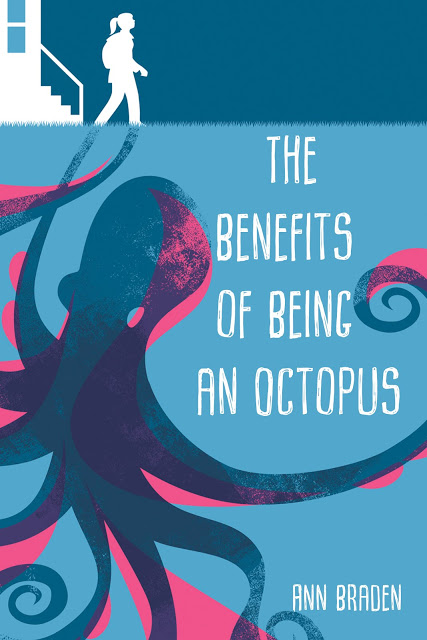
 We Emus are fluffing our feathers in proud excitement to announce that Ann Braden’s MG novel The Benefits of Being An Octopus will celebrate its book birthday tomorrow, September 4th. If only we had tentacles to wave in joy as well!
Read on to learn more about the book’s amazing author and her axe-shaped necklace, about how teachers can’t wait to use it to help students expand their empathy, and how librarians can advise patrons on its appeal factors. We’ll also have a whole ‘nother post about the benefits of being an actual octopus!
An Interview with Ann Braden
by Anna Redding
Anna: This book is written in first person. To do that, you really have to know your character. Zoey’s voice comes through crystal clear, illuminating her world
and way of thinking right out of the gate. It’s so well done, I have to ask, was that something y ou focused on crafting or did Zoey’s voice come to you with this kind of clarity?
Ann: Zoey’s voice came to me like that. It’s hard to describe, but in my heart I was Zoey when I was writing the book, so I just wrote down what I knew she would say or think. For me, it wasn’t about craft, it was just about listening.
Anna: When we first step into this incredible story, we step into a Zoey’s fascination with Octopuses (which we learn from her, doesn’t have to pronounced octopi, thank you very much). What is so brilliant, is that you suck us right into her irresistible curiosity, her enthusiasm, her lovable personality. The connection between reader and Zoey is immediate and as deep as when you bump into a new true best friend. Which is important, because this makes it possible for us to really go “there.” And, in this case,you are illuminating a story that often goes untold in America. Tell me about your decisions in crafting this aspect of the book.
Ann: When I was in the very early stages of conceptualizing the book, I read The Soul of an Octopus by Sy Montgomery, and I was utterly captivated. I loved that octopuses were so much like us –they form relationships,have different personalities, and are super intelligent – yet they had evolved in such a different way. I think there are parallels of that amongst people, too: we all have different experiences growing up (some vastly different), but at the end we’re all trying to do the best we can. And the more I explored the connection between octopuses and Zoey, the more she became just as obsessed with octopuses as I was.
Anna: At the same time, this story will be familiar to many readers who see themselves and their families in these pages… and yet their lives and experiences are often not on the subject of books. Have you heard from readers or teachers about what an important story this if for readers to be truly ‘seen’?
Ann – Yes. For kids growing up outside of the white, middle class culture, books that also take place in that culture can be an extra reminder that they don’t belong. (And of course, on the flip side of this, kids who are growing up in that culture can too easily ignore the range of other experiences if that’s all they see.) When I was teacher myself, I taught in several different schools, and I knew that there were kids like Zoey in every single one of them. My gut told me this had to be true on a broader scale, and the feedback I’ve been getting from teachers has confirmed that. And too often those kids have become so good at making themselves invisible that they fall through the cracks. But when we have books that discuss the issues that are central to their lives (but are rarely talked about in school) we are creating an opportunity for those students to see themselves as valued and to potentially connect in a way they hadn’t before. And EVERY SINGLE STUDENT deserves to feel valued and connected.
Anna: I loved what School Library Journal had to say about THE BENEFITS OF BEING AN OCTOPUS in their starred review: “Heartbreaking, beautifully written…Braden’s story raises many thought-provoking and timely questions about the difficulty of escaping poverty and the prevalence of fun violence.” That is such a powerful summary of a powerful book. What do you hope readers will take away from the pages of your book?
Ann: I hope that they come away recognizing their own strength (even if it’s not something that can be seen by others)and realize that how much money someone has has nothing to do with how hard they are working. And that no matter how powerless you feel, you always have the power of your voice.
Anna: This is a ‘must-read’ for schools and classes. How can teachers tie this into curriculum and for students, who are inspired to take action in their own communities, what ideas do you suggest or resources can you point them to?
Ann: I’m really excited about the conversations this book has already started. And since the book brings up topics that aren’t often discussed, it can be good to have supports in place. Here is an Educator’s Guide that I put together in partnership with Equity Solutions, a non-profit focused on leading powerful conversations about economic class with people from all kinds of class backgrounds. Besides discussion questions, it includes extension activities, such as analyzing a budget of someone who only gets paid minimum wage and working to find the common ground of a controversial topic in the community. I also created a Flipgrid where educators can reflect on key questions in the books and discuss. Plus, the introductory video on the Flipgrid highlights a few key ways to make sure that discussions of the book are empowering for kids.
Anna – Lastly, sometimes in life, in the most difficult of circumstances, you can see a lifeline emerge from the fog. For Zoey, it’s joining the debate club. What would you say toreaders about paying attention to those unexpected lifelines?
Ann – We never know where a choice will lead us, and it’s amazing what can happen when we say “Yes” to things. Even a small step forward can shift the ground beneath us in the best of ways. Still, sometimes if your head is down and you’reworking as hard as you can, no matter how many steps forward you try to take it seems like nothing will ever change. That’s when we need to be able to rely on allies who are ready to listen and those who are ready to team up and work to change the underlying systems that make it so hard for some to make end meet. We all have to look for the opportunity to be lifelines for each other. Because when you’re in that fog, it’s often not possible to do it on your own. We have to remember that we’re all in this together.
Anna – Okay, one more question. For all readers (of all ages), there is a message about taking hold of your own potential, which is why this book is hopeful. What would you say to us about this idea of claiming your own power as your hope?
Ann – Our own power is the tool that is ALWAYS with us, whether we can see it or not, and it’s up to us whether we wield it. When I was about two years into leading a movement in support of common ground gun laws in Vermont, something that I had never thought I would do and something that taught me I was far stronger than I had thought, I was catching my breath in the midst of months of 60-hour weeks. And in that quiet moment I was reminded that way back in middle school I had also discovered that I was stronger than I thought because that was when I first got into chopping wood. In that moment, I splurged on a small axe charm and I hung it around my neck because I knew there were many more steps I needed to take to help get gun laws passed, and I wanted to make sure I always remembered my own strength – and most importantly, remembered to wield it.
I kept that necklace around my neck in am-packed statehouse committee rooms and when I was the target of online bullying. And those people who were trying to intimidate me into silence weren’t able to. Because at the end of the day, my eyes were focused on the kind of civil discourse I believed the issue deserved and I had faith in myself that I could help make that happen. That’s why I had hope, and, ultimately, landmark legislation was able to get passed. Zoey’s situation is similar. She had hope because she had memories of what her mom used to be like, and she found a way to keep her eyes focused on what she loved. And when that hope was combined with her courage to use her voice, it shifted the ground beneath her. Maybe all kids get that same chance to find their voice and use it.
The Realities Students Face: A Discussion with Teachers
by Kat Shepherd
Ann Braden’s long-awaited debut, The Benefits of Being an Octopus, is a powerful read that is sure to be a staple for schools and libraries for years to come. It received a starred review from School Library Journal, and it’s gone into a second printing before it’s even been released. Following the story of seventh-grader Zoey, it is a deftly-told tale that is both heartbreaking and hopeful. Octopus highlights struggles faced by students living in poverty, and takes an honest and compassionate look at how those struggles play out both inside and outside the classroom. Zoey’s teacher, Ms. Rochambeau, plays an important role in Zoey’s life, so I decided to invite some educators to share their thoughts on this beautifully-written novel.
Q: When I read Zoey’s story I so wanted her to have that fairytale ending where everything works out perfectly, but the ending of this book, while hopeful, isn’t that perfect fairytale. Why is it important for kids to have books that don’t always have the perfect happy endings we want for characters?
Erin Varley: There are so many books out there that already have the fairy tale endings, so it’s just as important to have a lot of books that don’t have that ending. Life isn’t fairy tale perfect and kids figure that out really fast. In fact, for kids like Zoey, they figure it out too fast. For a kid to see that life, while not perfect, can still offer hope, well that’s just as important. Kids know when they are being lied to, and sometimes fairy tales can seem like that. They don’t buy the lies. Books like Octopus offer an alternate path that still is positive, but also realistic.
Kristin Crouch: I love the ending and agree that it not being perfectly wrapped up is a strength of the novel. In my school, I have so many fifth graders in transition. I’ve taught children in shelters, children who’ve moved several times through a year, children who move in with friends (resulting in 14 people in one two bedroom apartment), children in houses that have been condemned, children living in hotels until a new apartment is found (and those are just housing transitions!). Ending the book with Zoe in transition shows my students that transition is not, in and of itself, an ending… It proves what the teacher tries to convey to Zoe~ that she is not the product of her circumstance. She can, and will, make more of her experiences, but that doing so is not a quick, easy fix. It will take years of working hard to overcome her challenges.
Jennifer Druffel: I loved that it was not a fairytale ending! Kids need realistic books that mirror their own lives and see characters that can be strong despite their circumstances. Also, for kids who have never experienced such hardships, it helps them put themselves in someone else’s shoes and be less judgmental about their peers’ circumstances.
Cassie Thomas: Real life is not perfect, in any way. It’s so important for kids to be able to relate to stories, and if every student just reads books where everything turns out good in the end then in their life they may feel defeated and unsure. Every year I read Each Kindness by Jacqueline Woodson out loud to kids and the ending is not happy, it’s not perfect, but it’s real, and it leaves my students with jaws dropped and questions. Then they realize that in life they don’t get happy endings for every single thing. It’s a great message to have discussions over.
Q: Many adults have concerns that books dealing with issues like poverty and domestic violence are “too adult” for children to be exposed to. As a teacher, how do you respond to those concerns?
EV: Well, first I like to make sure each parent is heard. To be honest, I defer to the parent. If a parent tells me they don’t want a certain title being read by their child, I respect their wishes. However, I don’t remove the book from my library. Just because the book isn’t right for one certain child, doesn’t mean the same thing for every child. There might be another child in that same class that finds that book to be a lifeline, as I know Octopus might be.
KC: While I’m on the bandwagon that yes, these topics and concepts are too tough for kids, the fact is the kids who are exposed to it must know they are not alone. They are not invisible, they should not be hiding, and they will get through it.
JD: I would never force a student to read such a book. And if a parent is concerned, I’d ask them to read it first before they let their child read it so they can be the judge for their own child, but NOT for other people’s children!
CT: I teach 5th grade, and this comment irks me in a lot of ways. These students are SO mature and they truly know so much already. If they don’t, they are so eager to learn. When discussing social justice last year I had some outside people say this exact same thing, and my response was Do you know what your child is watching on TV? On their iPad? What the lyrics in their music actually say/mean? Because they do, they totally know. They are smart and they want to be treated like an adult, especially at this age. I make sure I choose my words wisely, but we do have discussions. The reality is that some kids in class ARE experiencing that life, who are we to act that it doesn’t happen when it is reality for some.
(Name Withheld): When I read Octopus I immediately said… “THIS is what my kids deal with.” Honestly… this book is exactly what some of my kids go through on a daily basis. The trailer park, watching their younger siblings, new boyfriends/girlfriends all the time. Not that this makes any of the parents bad people or bad parents, and I know that everyone is doing the best they can, but I know that some of my students deal with a lot and have a lot of responsibility that I never had as a kid. Which makes this book even more important to include in my library!! It is the first book I’ve read that I really felt MY student’s struggles come through.
Q: When you read this book how did you envision it as a teaching tool in your own classrooms?
EV: I’m not sure I plan to read this book as a read aloud, but def as one to include and book talk in my classroom. I thought perhaps an excerpt would work as a discussion tool. Many tough topics are written with grace and hope, and kids need to see that tough times are not the end of the world, that things can get better, and that sometimes people need help or are doing the best they can in that moment.
KC: I was hoping to use this book to spark a discussion about verbal abuse. What it is, what it can sound like, and how it can affect your own thoughts about yourself and your abilities. From there, I was hoping to discuss negative and positive self talk as well. Even the character of the boyfriend’s father who lived in the house added to the stress. While he was less insulting toward the kids, they were living in a home in which people didn’t adore them~ they barely tolerated them. This affects the psyche, and I want my students to be able to recognize it so they can try to protect themselves any way they need to.
JD: I would book talk this book to my classes and then students can choose to read it if they wish!!
CT: As an educator I can’t even begin to explain to you the quiet importance that Ms. Rochambeau plays in this story. This will be a book that will not only be a very vital window for students to look in, but also a mirror to know they aren’t alone. Ann has touched on topics that I know for a fact students experience, or something similar, on a day in, day out basis, but are not quick to speak up. I feel as though all middle grade students and teachers need to read this book, and soon… One of our school wide behavior expectations is empathy and this book provides the opportunity to teach and understand empathy in Zoey’s life.
Q: I love that Ann views books as means of bridging the divides between people, as is evidenced in her excellent podcast with Saadia Faruqi. One thing I loved about Octopus is that it delves into the the complexity of issues that are often painted as simple black-or-white answers in the cultural narrative. What can educators do to help students find the complexity in these hot-button issues?
JD: It would be awesome to have a book club of students discuss this and their opinions on those issues!
CT: A way that I foresee us bringing up the complexity is giving multiple experiences and then having discussions, constantly. Everyone’s story isn’t the same in real life and Zoey’s story is one that some may relate to in SOME ways but not all ways, or the entire way. Another way is that I love for students to start figuring out solutions. What could we do as a community to help make these situations better.
Q: My husband, who grew up poor, talks often about how profoundly his life was impacted by a teacher who encouraged him to apply to a free Jesuit high school in Manhattan. He is still moved when he talks about what it meant for him to have an adult see him and believe that he had something great to offer the world. Jarrett Krosoczka still remembers being in school and having an author visit from Jack Gantos. Jack complimented Jarrett’s drawing of a cat, and it’s part of what encouraged him to become an author/illustrator. Zoey has Ms. Rochambeau. Who were those adults in your lives that encouraged you, and how do you see your role as teachers in helping kids reach their potential?
EV: I think about coaches first, actually. I was so involved with swimming and my coaches were the ones who stick out in my mind. They believed in me and saw potential in me that I didn’t always see. Encouraging kids and helping them see their good and their successes are what I try to do as a teacher. Always staying positive and helping develop a growth mindset are also things I try to encourage.
JD: I strive to let EVERY child I teach know they are valued for who they are. I notice strengths in each child and point them out often. I listen to let them know their voice is important. I can only hope that this will make a difference!!
CT: One of the educators who played the biggest role in my life was my middle grade creative writing teacher. I was going through a lot. Bullying was unbearable (to the point where we moved my 8th grade year), but Mrs. Ward helped me learn to write, how to escape that reality that I was dealing with and get thoughts out on paper through poetry. I was published. I was proud. I was finally happy. I knew that at that moment I wanted to be that light for students. There were a lot of teachers who weren’t there for me because they were friends with the parents of the students who were being ugly, so they just brushed my stresses aside. I knew then what I did NOT want to be as an educator. I feel that it has helped me significantly in building relationships and also with helping place that heart print book in the hands of a child who needs it. I don’t ever look at myself as a “savior” but an extra mom so to speak. I have told them I wear many hats as a teacher and I want nothing more than our classroom to be a safe place for them. So far it has proven to be just that.
Many thanks exceptional educators like Erin, Kristin, Jennifer, Cassie, and others for taking the time to chat with me and celebrate the debut of The Benefits of Being an Octopus. We are so excited to help welcome this wonderful book into the world! For teachers who want to join this discussion, please visit Ann’s Octopus Flipgrid.
The Appeal Factors of Being An Octopus
by Christina Uss
Let’s not forget how librarians are going to get this tender, tough, many-tentacled story into the hands of readers. I was lucky enough to get some training as a library assistant last year and learned about successfully matching a reader with their next read as a reader’s advisor. One of the keys to advising wisely is ferreting out a book’s APPEAL FACTORS, which turns out to be way cooler than solely recommending titles by t

he same author or the pushing the newest thing in the same genre. Thanks to the metadata librarians at NoveList, we’ve got a whole list of potential appeal factors, and I consider it an honor to be the first to point out to all librarians how they might describe The Appeal Factors of Being An Octopus:
- Character – the main character is believable, relatable, courageous, likeable, spirited, strong, and well-developed. Kids are going to wish Zoey was their big sister, especially those who already know all about the eight-armed juggling that comes with taking on caregiving tasks for siblings (and sometimes parents) at a young age.
- Writing Style – candid, compelling, engaging, with well-crafted dialogue. The book satisfyingly fills our minds’ eyes with rich details that make Zoey and her friends and family come alive (and our minds’ mouths with the comforting scrunch of Easy Cheese and crackers.)
- Pace – intensifying. Will everything work out for Zoey and her family? How??
- Storyline – both plot- and character-driven, mixing uncertainty in plot with Zoey’s determination
- Tone -often intense with an emotional edge, moving from heartwarming to heart-wrenching, hopeful, sobering, eye-opening, thought-provoking, with a strong sense of place.
I can’t wait until Tuesday when my library system will load in its first copies of this fabulous and I can start advising readers to check it out!
Ann Braden writes about kids struggling to find their voice despite the realities of life, and about cultural divides and possibilities for bridges across. She writes because even when life is throwing the entire kitchen at you…there is HOPE. Come chat with her on Facebook, Instagram, or Twitter.

 We’re continuing our celebration of the debut of Hayley Barrett’s eagerly-awaited picture book, Babymoon! Emu’s Debut’s Kat Shepherd got to catch up with Hayley to ask her a few questions about her gorgeous debut.
 I want to emphasize that every growing family deserves a babymoon. Whether heading home with a baby graduating from the NICU, adopting 8-year-old siblings, or welcoming a full-term newborn—whatever their particular situation—families deserve time to rest, learn, and fall in love. They deserve our patience, our support, and they definitely deserve our yummy casseroles.
 I baked and froze a Birth Day cake for each of our babies in anticipation of their arrival. Our daughter’s was chocolate with chocolate frosting—her dad’s favorite—and our son’s was carrot cake with cream cheese icing—just like our wedding cake. After each birth, when Baby was swaddled and everything settled down, we put a candle in the cake, lit it, and sang Happy Birthday to them for the very first time. It’s a lovely memory.
 YES! The time to plan a babymoon is before the new little one arrives. Family, friends, neighbors, and others can work together to meet everyday needs like food, errands, pet care, and more. Sometimes, the most important baby gift we can give is space and time. When a baby arrives, we’re all excited to visit, but respecting a new family’s privacy is important.


 Joan: Oh, wow—that is a very long time ago for me! It’s funny, but I don’t seem to have a lot of specific or anecdotal memories of those very early days (sleep deprivation much? 😊). Instead I just remember a sort of warm haze over the time, a feeling of utter warmth and completeness, like everything I could ever want or need was right there within my arms’ reach. And every time I read BABYMOON it’s like getting that feeling back, just for a moment.
 Have you ever seen an emu egg? They are spectacular, blue-green, dragonish things.
 In my opinion, they’re way prettier than real dragon eggs. (Sorry, Dany.)
 The proud papa will dote on these chicks for the next year and a half, nurturing them and teaching them to be good emus.

 I write for young people and live to make kids laugh. My picture book BABYMOON celebrates the birth of a new family and is coming from Candlewick Press. WHAT MISS MITCHELL SAW, a narrative nonfiction picture book illustrated by Diana Sudyka, is coming fall 2019 from Simon & Schuster/Beach Lane Books. GIRL VERSUS SQUIRREL, a funny STEM-based picture book, is illustrated by Renée Andriani and coming from Margaret Ferguson Books/Holiday House, summer 2020. I’m represented by Ammi-Joan Paquette.


 in a giant, celebratory, Emu hug.
 ABDOPUS (like octopus…with great abs) ACUEATUS, also known as “algae octopus,” the only “land” octopus. It lives on intertidal beaches and crawls along the sand from tide pool to tide pool in search of food. You have to see it to believe it, and remember, once you see it, you can’t unsee it.
 is more commonly known as the Dumbo octopus. I like the name “Grimpoteuthis” far better than “Dumbo,” but I get why this critter got it’s Disney-ish name. It flaps ear-like fins to propel itself, flying underwater like an animated elephant. It also has bright baby-blue eyes, just like—you guessed it!—Dumbo.

 The blanket octopus is immune to the viciously venomous sting of the Portuguese man-o-war. Since the female blanket octopus is 4000 times larger than the male, she’s the one who collects and brandishes the marine hydrozoan’s whip-like tentacles, Scientists believe the octopuses employ the tentacles for offense and defense. Look out, Aquaman!


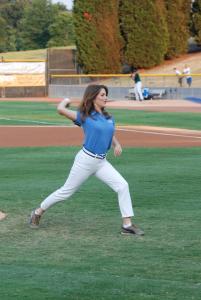 I don’t even know where the ball went, but certainly nowhere near the plate. To say it was embarrassing is an understatement.
 you’ll find one. I did!
 Anna Crowley Redding’s lively nonfiction debut, GOOGLE IT!: A History of Google from Feiwel & Friends brightens up nonfiction shelves across the nation tomorrow, August 14, 2018. We here at Emu’s Debuts can’t recommend it highly enough – read on to learn how Anna’s book will enlighten students and engage reluctant readers, plus find out how editor Holly West started Anna down the path to publication.
 Suddenly, I could point to Poster #4 to congratulate a student for finding a new way to attack a problem, or point to Poster #1 when a student tried to turn in a rushed assignment. It made it clear that there was no such things as smart or stupid: the only difference was one’s willingness to attack something with whatever kind of effort is needed. It was empowering for me, and most importantly, for the students.
 I have avidly devoured nonfiction since childhood, partly because I love learning new things, but even more so because every new book reminds me that the world of facts is far more interesting than we could even begin to imagine.
  designer, Raphael Geroni, who did a wonderful job. But Anna and I did have a few conversations about the inclusions of sidebars and inserts. We wanted to book to feel right to an audience used to reading online, and we both have a tendency to take










 acevedowrites
 Adam Shaughnessy
 annacrowleyredding
 Ann Braden
 carolegerber
 Christina Uss
 Christine Hayes
 Cynthia Levinson
 Darcey Rosenblatt
 Debbi Michiko Florence
 Donna Janell Bowman
 elainebvickers
 Elly Swartz
 emusdebut
 Hayley Barrett
 Jennifer Chambliss Bertman
 Janet Fox
 Jason June
 katieslivensky
 kevanjatt
 Andrea Wang
 Lily Myers
 Luke Reynolds
 mariagianferrari
 Megan Morrison
 Mylisa Larsen
 Penny Parker Klostermann
 Courtney Pippin-Mathur
 Calista Brill
 Rebecca Van Slyke
 sarvindern
 Kat Shepherd
 Susan Vaught
 tamaraellissmith
 EMU's Debuts